As soon as you start that open water dive course there is talk of dive tables. These seem like quite a scary thing but once you learn how to use one table then you understand the mechanics on how to use the others. They all follow pretty much the same rules. But one thing that can be confusing is which table to use? There are tables for air diving, tables for decompression diving, tables for EANx diving, and tables in your home. So what do you use? You use the ones that you were trained on.
Bühlmann Air Decompression Tables
Bühlmann Air Decompression Tables are used by several different dive agencies. So if you make the move to an agency that uses them it is worth learning how to plan dives with them, are the slightly different from the standard PADI dive tables. If you haven’t used the PADI dive tables in awhile why don’t you check out my post on how to use the tables to plan a repetitive dive to brush up your skills.
So let’s discuss the Bühlman Air Decompression Tables. If you want to take a look at them you can find them here. Like PADI’s tables there are 3 of them. Here is an extract from the first table:

By default these particular tables require a 1 minute “safety stop” / “deco stop” at 3 meters. That is the default for these tables and it differs from what PADI’s RDP where a safety stop is recommended at 6 meters for 3 minutes.
This is showing dives up to 9 meters. It shows four possible times: 25, 37, 55, and 81 minutes. That means if you do a dive at 9 meters for 37 minutes you are required to do a 1 min safety stop at 3m. And you will be in pressure group B after you have completed your dive.
You can also see that the extract has entries for decompression stops at 12, 9, 6 and 3 meters. The first table has similar entries going up in 3 meter intervals to a depth of 60 meters!!! That is way beyond what recreational diving allows and what a lot of agencies prescribe: no-stop diving it is not.
Let’s look at the extract for 30 meters depth (the depth you are allowed to go to as an Advanced Open Water Diver, you’re not allowed to do decompression dives as an AOW).
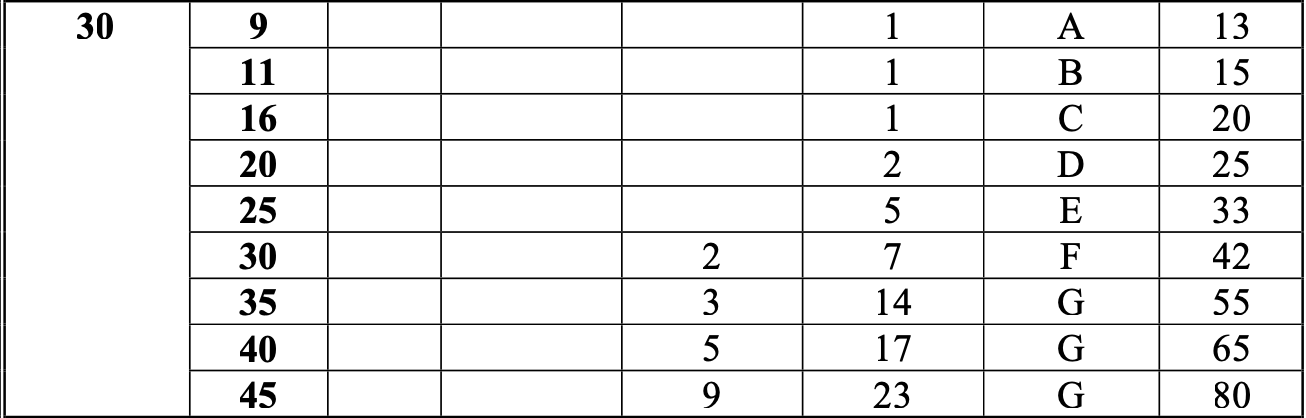
If we compare that to your PADI tables: a 30 meter dive has a maximum bottom time of 20 minutes. These tables show what happens if we stay longer at that depth. If we stay up to 25 minutes our stop at 3 meters doubles from 1 minute to 2. At 30 minutes we now have to do an addition stop at 6 meters for 2 minutes, and then 7 minutes at 3 meters. you can easily see how quickly the decompression obligation rises.
Safety Stops at 3 meters?
Why does the table have a stop at 3 meters for 1 minute? Well firstly these tables predate modern recreational dive planning, and there have been many advances in the theory since these tables were written. Does it mean these tables are wrong? No, it doesn’t. Bühlmann’s model is a dissolved gas model, and with that model it is more efficient to be at 3 meters than at 6 meters, 1.3 ATA vs 1.6 ATA. That maximises the pressure gradient for off-gassing while staying within the model’s M-values. That is why the final stop is at 3 meters.
Many dive tables had stops at 3 meters / 10 feet. The original 1908 Royal Navy Dive tables have them.

So why don’t we do that today?
Firstly for ease. Controlling buoyancy in shallow water is difficult. Have you noticed on a dive that at the safety stop some people really struggle to stay at one depth? Small changes in depth in shallow water have a greater effect on the air in your BCD. So making it easier for divers to do a “safety stop” means that it is more likely they will do them. Even if your buoyancy is perfect, swell can easily move you up a couple of meters at a time so trying to stay at 3 meters can be difficult, as one minute you’re at 3 meters and the next you are on the surface effectively skipping your decompression obligation.
Secondly, during the 80’s & 90’s, Doppler studies showed that venous gas bubbles formed during no-stop dives, so agencies like PADI pushed hard for a “safety stop” at 5-6m for 3 minutes. This was shown to reduce venous gas bubbles, and reduce DCS risk. And as PADI is one of the biggest dive agencies in the world, it is no wonder their standards have proliferated through to become common dive practices.
Should you dive the Bühlmann Tables
Have you had formal training on them from a dive professional, or have you just read an article on the internet? Honestly, you should not dive these tables unless you have had formal training from a dive agency. You shouldn’t do it. Go get proper training.
Also the majority of people do not use tables for planning dives these days. Most people use a dive computer and a lot use the Bühlmann ZHL-16C with Gradient Factors algorithm. Yes, it does sound similar to the tables listed here. They belong to the same family but will produce different results. Computers are able to perform more granular computations and handle dives that are not a square profile so it would be unlikely to see the same results from tables as a computer. I don’t think you can even pick 3 meters as your “safety stop”, on most dive computers it is fixed at 6 meters. Though computers like the Shearwater Perdix 2 does allow you to set your last stop as 3 meters, instead of 6 meters, if you put it into the Open Circuit Tech mode. So it is possible to follow it, but I think my Suunto Vyper or D9tx don’t (they are currently getting serviced so I cannot check).
Let’s plan a dive
Did you not read the section before? You did, well let’s look at how you would plan some repetitive dives. For a comparison let’s follow the same dives that I planned before on PADI’s RDP. If you haven’t gone through that lesson, go back and do it now.
Here are the dives:
Dive 1: 15m for 40 minutes with a 65 minute surface interval
Dive 2: 13m for 26 minutes with a 40 minutes surface interval
Dive 3: 11m
So firstly we are doing a dive to 15 meters for 40 minutes. The Bühlmann tables have an entry for that that leaves us with pressure group D.

Next we need to calculate our pressure group after the surface interval. So this is where we take our first look at table 2. We start with the beginning group that we were in which was D, we have a surface interval of 65 minutes, so anything over 30 minutes is going to give us a group of A.

So we now need to just to table 3. This is where we calculate our residual nitrogen time (RNT). Our next dive is going to be to 13 meters. The table has entries for 9, 12, 15, 18 meters etc. You might think that since 13m is less than 15m our residual nitrogen time would be 16 minutes, however this is not how this table works, instead of rounding up here, we round down and choose the more conservative 12 meter entry giving us a RNT of 19 minutes.

Dive 1 is complete, we can now do dive 2. So we have a RNT of 19 minutes, and dive 2 is 13 meters for 26 minutes. Table one has entries for 9m, 12m, and 15m. So to be conservative we use the 15m entry. To calculate our new bottom time we take the RNT and add it to the planned bottom time 19 + 26 = 45 minutes. The table doesn’t have an entry for 45 minutes, we pick the next entry which is 59 and we end this dive with a pressure group of E.

Surface interval of 40 minutes gives with a starting group of E gives us an ending group of B. Note that since 40 is less than 45 we choose column B as that a surface interval of 25 minutes of more but less than 45 minutes.
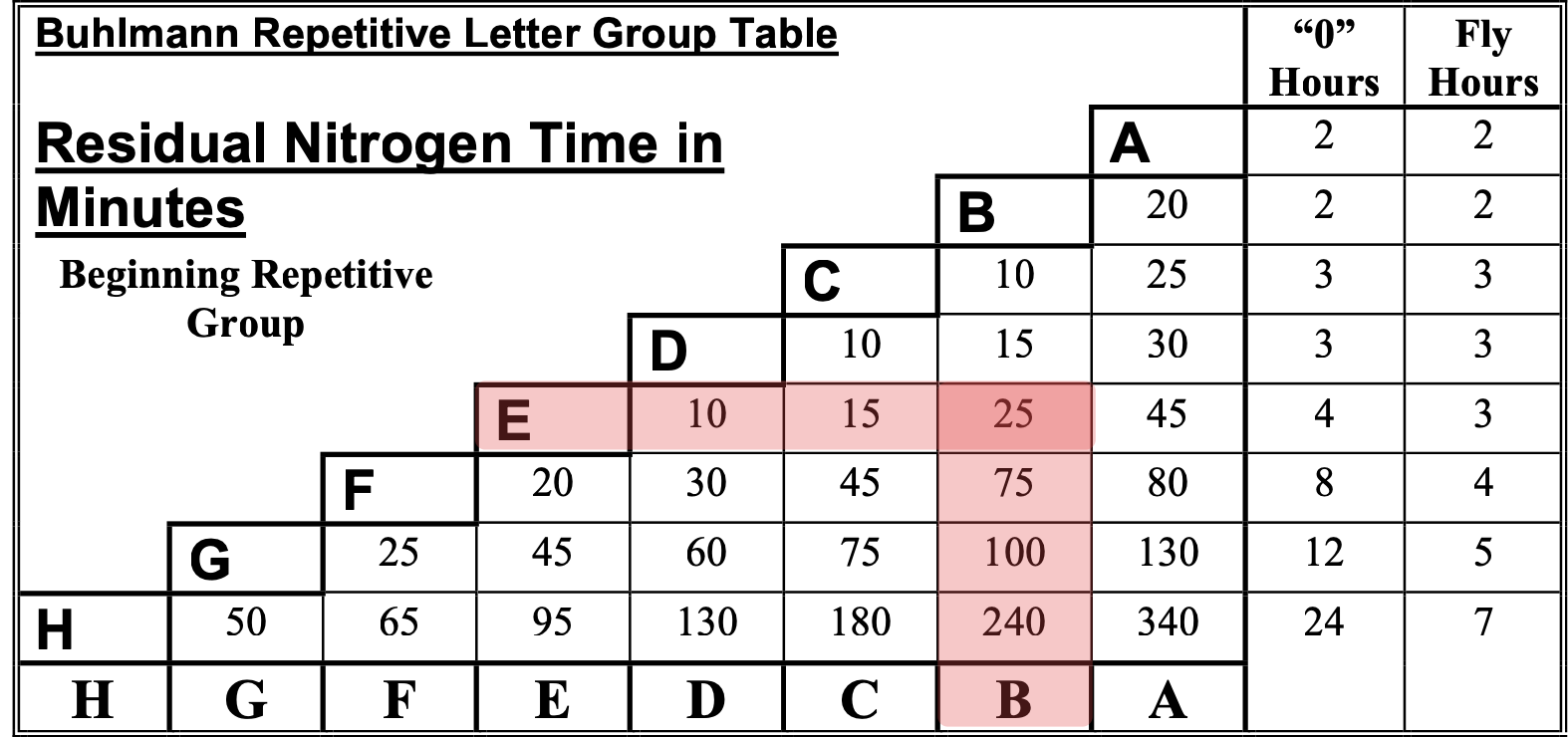
Let’s calculate the RNT so we can then plan dive 3. Similar to the end of dive 1, 11 meters does not map nicely onto the table. We take the most conservative option again which is to plan for 9 meters giving us a RNT of 37 minutes.

So it’s time for our final dive down to 11 meters. But how long can we stay down without going into mandatory decompression? Let’s look back at table 1. This time we use the 12 meter entry.

We have an RNT of 37 minutes. The maximum adjusted time listed at 12 metres is 82 minutes, so:
82 − 37 = 45 minutes
We can therefore spend a maximum of 45 actual minutes at 11 metres before the table requires additional decompression beyond its standard one-minute stop at 3 metres (which this table does not give for these depths).
This differs considerably from the PADI RDP calculation, which gave an Adjusted No-Decompression Limit of 112 minutes.
What does this mean?
This doesn’t mean that PADI’s tables are wrong, or that the Bühlmann Air Decompression Tables are wrong either. It just means that they are different. They are models, and they predict what will happen. Diving tables are not an exact science. I am sure you have been told during your diving training that you can follow the tables/computer exactly and do everything 100% and you still can get decompression sickness (DCS).
The different result from both tables is the main reasons why you should never switch between different dive tables during a series of repetitive dives, and why your dive buddy should plan using the same tables as you. Different table systems can produce significantly different results for exactly the same dives.
A pressure group from one set of tables is not equivalent to the same pressure group in another. Although they may use the same letters, those letters represent different levels of residual nitrogen and are calculated using different assumptions.
You can even see this within the PADI RDP itself. The metric and imperial versions of the tables do not always produce identical no-decompression limits for equivalent depths because the depths are rounded differently. For example, 18 metres and 60 feet are close, but they are not exactly the same depth. As a result, you should not switch between the metric and imperial RDP during a repetitive dive series. Pick one version and use it consistently.
First and foremost let me state that you must receive formal training from one of the many dive organisations before attempting a dive. Without formal training you risk injuring yourself. Please get training before attempting anything you have read or seen in this post. I will not be held responsible for you attempting to use the methods contained in this post. This post is for illustration purposes only.

